
Eczema Integrative Treatment: What It Includes and How It Works


Integrative treatment for eczema (atopic dermatitis) means building a plan around proven medical care, then adding approaches that support the skin, the gut, sleep and stress. It does not replace your medicines. A 2024 review in PMC found that mind–body therapies added to conventional itch treatment may improve itch, pain, anxiety, sleep and mood, and it stresses that effective conventional treatment should not be delayed. At Green Circle Wellness in Chicago, our integrative team gives you ample time to work through your history and build a personalized plan, including functional medicine.
TL;DR
Integrative eczema care layers daily skin care, trigger review, gut and nutrition support and stress tools on top of standard treatment.
Moisturizing at least twice daily, soon after bathing, is the foundation that guidelines agree on.
Gut evidence is promising but uneven: probiotics show benefit in some children, while broad elimination diets are discouraged.
Supplements and herbal products need a clinician’s review, since some products have been found to contain hidden steroids.
Severe, infected or unresponsive eczema needs prompt medical assessment.
Table of Contents
What integrative eczema care actually includes
Eczema is a chronic inflammatory skin condition with a weakened skin barrier and an overactive immune response. Flares are driven by many things at once: dry skin, irritants, allergens, infections, stress and poor sleep. That is why one cream rarely tells the whole story.
An integrative plan usually has five layers:
Medical treatment: topical anti-inflammatories, and for moderate-to-severe disease, phototherapy or systemic medicines.
Barrier care: moisturizers, bathing habits and gentle products.
Trigger review: allergens, irritants, food reactions that are real rather than assumed.
Gut and nutrition support: diet quality, and probiotics where the evidence fits.
Mind–body support: stress, itch-scratch habits and sleep.
The 2024 review above lists education, cognitive behavioral therapy, habit reversal, mindfulness, hypnotherapy, biofeedback, progressive muscle relaxation and massage among the tools studied. If scratching is partly a habit or a stress response, simple mindfulness exercises are an easy place to begin.
The foundation: daily skin care
Every guideline starts here, and an integrative plan does too.
Moisturize at least twice a day. The EuroGuiDerm guideline (March 2025) recommends applying emollients right after bathing, after gentle pat drying, using a hydrophilic base such as one containing urea or glycerol.
Mind the 3-minute rule. The SARE/SES consensus guideline says applying moisturizer within 3 minutes of a bath enhances effectiveness. It also suggests adults use over 250 g a week.
Coconut oil is not a moisturizer substitute. EuroGuiDerm says pure oils instead of emulsions can dry the skin and increase water loss, so they are not recommended. The SARE/SES guideline notes only mild anti-inflammatory effects for coconut oil.
Do not choose by label. The 2026 JAAD pediatric guidelines strongly recommend moisturizers in general but cannot recommend one product or ingredient.
Medical treatments that sit at the center
The strongest evidence is for conventional treatment, and integrative care works best when it is built on it. Over 100 trials confirm that topical corticosteroids reduce itch, control active disease and prevent relapse, according to the SARE/SES consensus. Strong evidence supports intermittent medium-potency use twice weekly to prevent flares. The same guideline cites a Cochrane review of 32 phototherapy trials supporting narrowband UVB for moderate-to-severe eczema.
The American Academy of Dermatology’s adult recommendations also back non-steroid creams such as tacrolimus, pimecrolimus, crisaborole, roflumilast and ruxolitinib. For moderate-to-severe disease they recommend biologics such as dupilumab, tralokinumab and lebrikizumab, and JAK inhibitors for people who have failed other systemic therapy. Your dermatologist or allergist prescribes these. Our role is to coordinate the rest of your care around them.
The eczema–gut connection
People with chronic eczema often ask whether the gut is the root cause. The research points to a real link, but not a simple one.
What looks promising. A 2024 systematic review found that adults with atopic dermatitis had more Bacteroidales, Enterobacteriaceae and Clostridium in stool, while healthy people had more short-chain fatty acid producers. Probiotics, fecal transplants and balneotherapy changed the gut flora and were associated with improvement. The authors say larger analyses are still needed. In children, a 2026 gut–skin axis review reports that a 2024 EAACI Task Force meta-analysis found probiotics, alone or with prebiotics, reduced SCORAD (the standard eczema severity score) in children without confirmed food allergy.
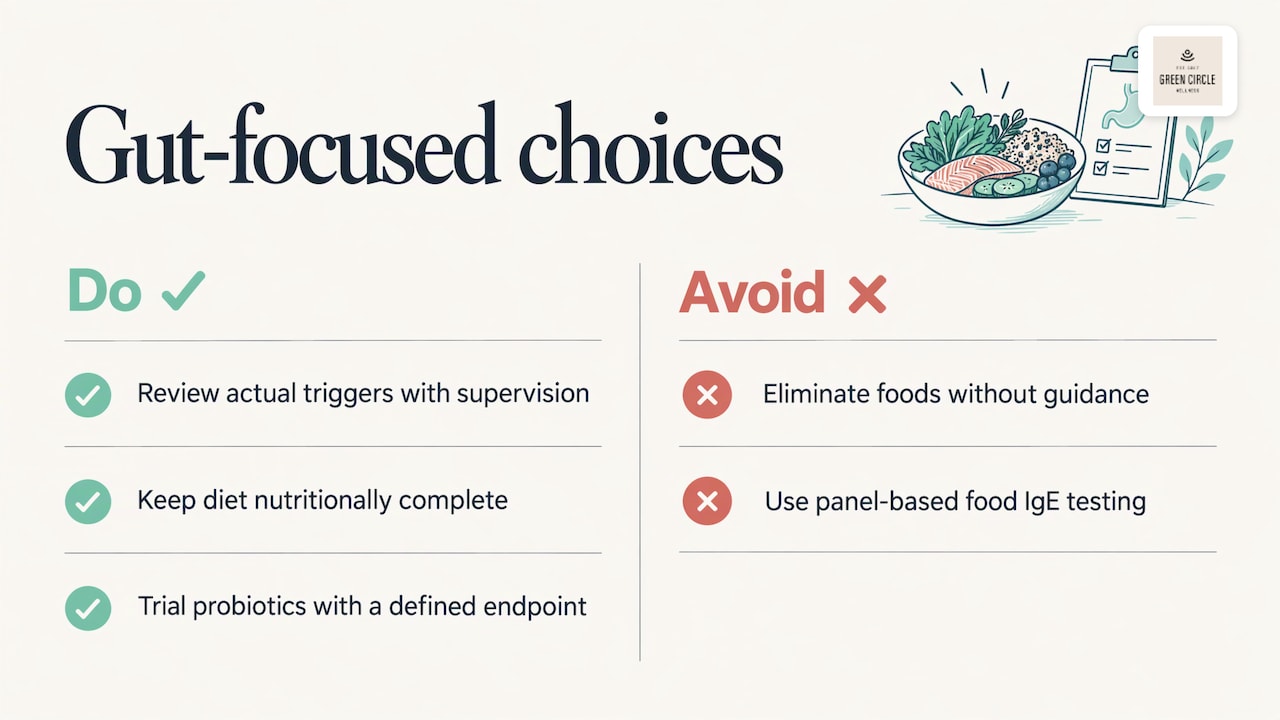
What to approach carefully. A 2025 JAAD diet update says probiotic evidence involves a limited set of strains and is low certainty. It also reports that the allergy societies’ joint task force recommends against dietary eliminations, and that panel-based food IgE testing should be avoided because it leads to unnecessary food avoidance. Being sensitized to a food on a test is not the same as having a true food allergy.
So a sensible gut-focused approach is not a long list of banned foods. It is a supervised review of your actual triggers, a nutritionally complete diet and, where appropriate, a trial of a probiotic with a defined end point. Our guides on IgG versus IgE testing and food sensitivity testing explain what each result can and cannot tell you. If allergy is part of your picture, see our advanced allergy therapy.
Supplements and complementary products
This is where careful guidance matters most. The NCCIH reports that the AAD guidelines found inconsistent to no evidence for fish oil, evening primrose oil, borage oil, zinc, vitamin D and vitamin E in treating eczema. A 2019 meta-analysis noted improvement with vitamin D at 1,500 to 1,600 IU for up to three months. It also warns that some Chinese herbal medicines are unregulated and that topical products have contained high concentrations of dexamethasone, a steroid.
Eczema UK’s guide for health professionals adds that “natural” does not mean safe, and that eczema can improve on its own, which makes it tempting to credit whatever you tried last. Its advice: keep using your emollient, and discuss any complementary treatment with your doctor to rule out interactions. Its patient page says complementary therapies are never a cure.
In practice, that means bringing every supplement and product to the visit. Choose products with a full ingredient list and clear instructions, and avoid anything sold with cure claims. Light-based wellness tools are also marketed for skin; photobiomodulation dosing is worth understanding before you try anything of the kind, and your clinician should know about it.
When to see a clinician
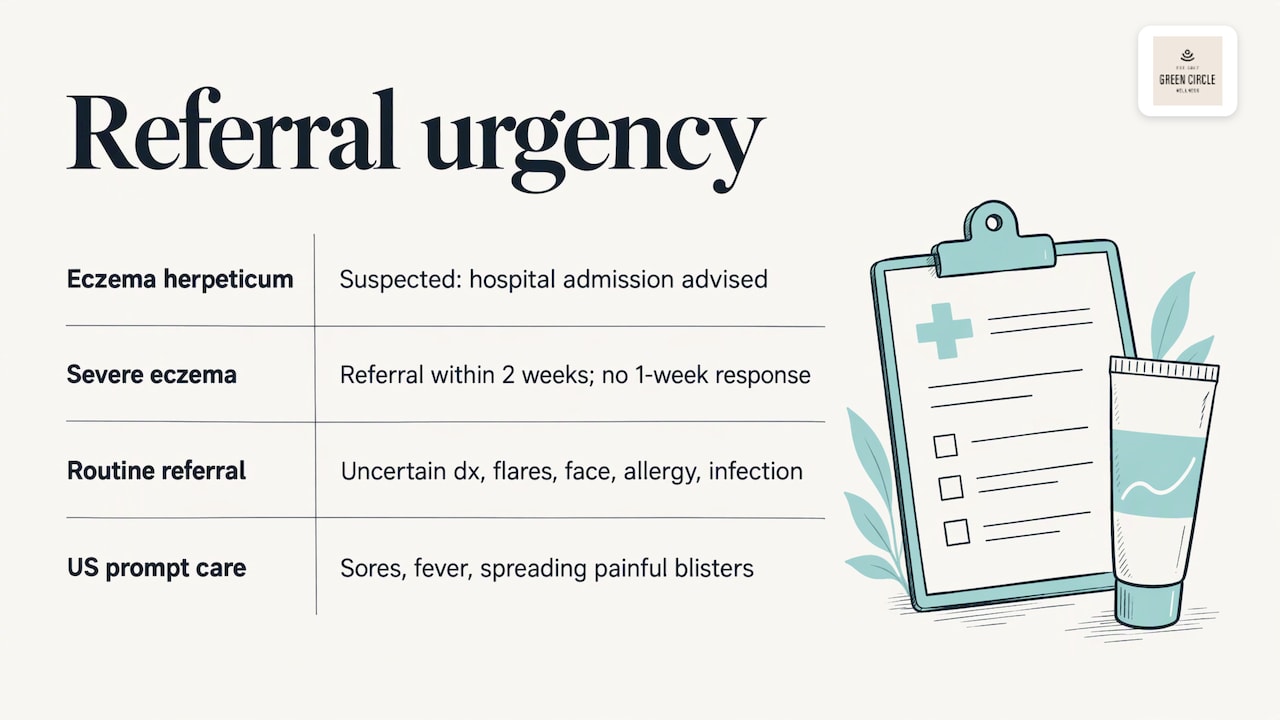
Some situations should not wait for a wellness plan. NICE guidance advises hospital admission if eczema herpeticum, a painful viral skin infection, is suspected. It advises urgent dermatology referral within 2 weeks if severe eczema has not responded to optimum topical treatment after 1 week. Routine referral is advised for uncertain diagnosis, uncontrolled flares, unresponsive facial eczema, suspected contact allergy, recurrent infection, or significant social or psychological effects. This guidance is from the UK, but the warning signs apply broadly. In the US, call your doctor or urgent care promptly for punched-out sores, fever, or rapidly spreading painful blisters.
How to build your plan
Bring your history. Note when flares began, what coincides with them, every cream, pill and supplement, and how itch affects your sleep.
Confirm the diagnosis and severity with a physician, so medical treatment is matched to your disease.
Review triggers properly. Decide which tests make sense and which would only create needless restrictions.
Choose one change at a time. Add one gut, nutrition or stress tool, give it a defined trial period and track itch, sleep and flares.
Reassess. Eczema fluctuates, so measure against your own baseline over weeks, not days.
If you also live with an autoimmune condition, or take medicines for one, this review matters even more because of overlapping immune pathways and interactions.
Perspective
Eczema rarely has one cause, so a single cream or a single supplement rarely settles it. What we see as the strength of integrative care is time: time to hear the full story, to look at the skin, the gut, sleep and stress together, and to decide which tests are worth doing. Our approach is evidence-driven. We keep proven medical treatment in place, and we ask the same question of every addition: what does the research support for this person? That is how a plan stays personalized without becoming a pile of products. Our multidisciplinary team works together so you are not carrying your results from one office to another alone. Dina
Work with an integrative team in Chicago
Green Circle Wellness is an integrative care center in Chicago, offering virtual consults for Illinois, combining conventional medicine with evidence-based therapies. Our services include functional medicine, nutritional consultations and gut flora optimization. You can see the full list on our services page.

If eczema has taken over your sleep or your confidence, start with an appointment where there is time to talk it through. Read more about how we approach care.
FAQ
Can integrative treatment cure eczema?
No approach has been shown to cure eczema, and Eczema UK states complementary therapies are never a cure. The goal is fewer and milder flares, better sleep and a plan you can keep up. Integrative care adds to medical treatment rather than replacing it.
Does fixing my gut clear eczema?
Not reliably. Research links gut bacteria and eczema, and probiotics helped some children without confirmed food allergy in a 2024 meta-analysis. But the 2025 JAAD update rates probiotic evidence as low certainty, so any trial should be supervised and time-limited.
Does coconut oil help eczema?
Guidelines do not recommend pure oils in place of a proper moisturizer, because they can increase water loss. A cream or ointment with a hydrophilic base, applied within 3 minutes of bathing, is the better choice.
Should I cut foods out of my diet?
Broad elimination diets are discouraged by the allergy societies’ joint task force, because of little benefit and potential harm. If you suspect a specific food, have it evaluated by a clinician before removing it.
Sources
Recommended
This article is for education only and is not medical advice.

Comments